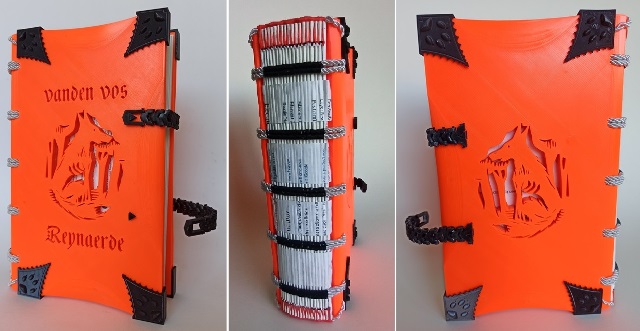

Did you know you can make a medieval binding with a 3D-printer? Yes, you can! Together with Sanne van Boheemen I made a modern Gothic binding, using 2 types of 3D-printing.
This 3D-adventure starts in 2019 when Stichting Handboekbinden, in collaboration with Atelier De Ganzenweide, published the standard work Van den vos Reynaerde in loose quires. Sometimes they add a competition to this special publishings, but this time it was a challenge: ‘bind the book with a wink to the middle ages’. Everybody who accepted the challenge was invited to contribute with their book to a exposition and a catalogue.
I never participated in this kind of competition or challenges, but this time i had to! I am specialized in making medieval bindings, so a challenge to make a binding for a medieval tale with a wink to the middle ages… I couldn’t resist.
I had already played with the idea of using the 3D printer for a book binding, but due to my complete ignorance in the field of CAD drawing, it remained a vague idea. For this challenge the idea arose to make a completely correct fifteenth century Gothic binding but with only modern materials including a 3D-printed cover. I contacted 3D printer Sanne van Boheemen, a friend of my husband, and he was happy to take up the challenge with me.
Sanne had no experience whatsoever with bookbinding. I gave him several loose boards and books so that he had a first idea of what had to be made. My biggest challenge was to explain in layman’s terms the binding of a Gothic binding, but Sanne understood everything immediately and transformed my words in a perfect AutoCAD design.

For the colours we choose to stick with the fox: orange, white and black. Although I wanted to go for a safe brownish orange at first, Sanne showed me a roll of PLA filament, a sort of bio degradable PET plastic, that was almost fluorescent orange. I didn’t like the color at all, but it was the right color for the boards of this binding. It almost screamed ‘I’m made of plastic’!

Our binding had to approach a fifteenth-century Gothic binding as much as possible. So not only the binding structure of tunnels, holes and slots for the ropes, but also the beveled edges, blindtooling and book fittings. Partly because we planned this for the challenge, partly because we wanted to make the most of all the possibilities that a 3D printer offers.
I planned to sew the quires to 5 double ropes, as was common for the Gotihic binding. The ropes were ofcourse modern: white, synthetic material. The same rope I used for the basic of the endbands. Sanne integrated all the holes and tunnels needed, into the design. We made bevelled boards but only in the middle of the boards for the corners would be covered by furniture.

I sew the bookblock with synthetic black yarn (made for sewing jeans 🙂 and the endbands with synthetic embroidery yarn in the same orange as the boards.

Blindtooling
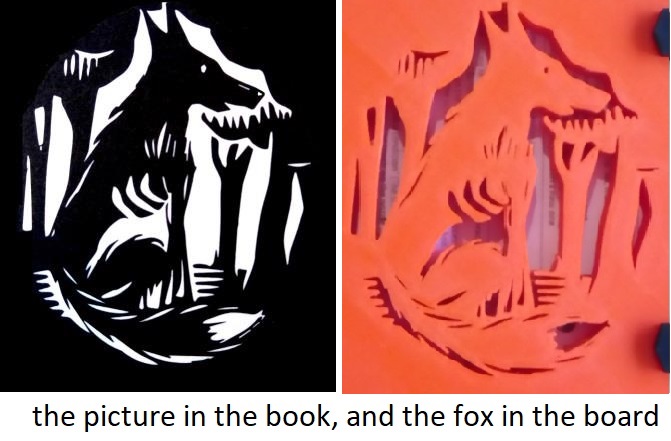
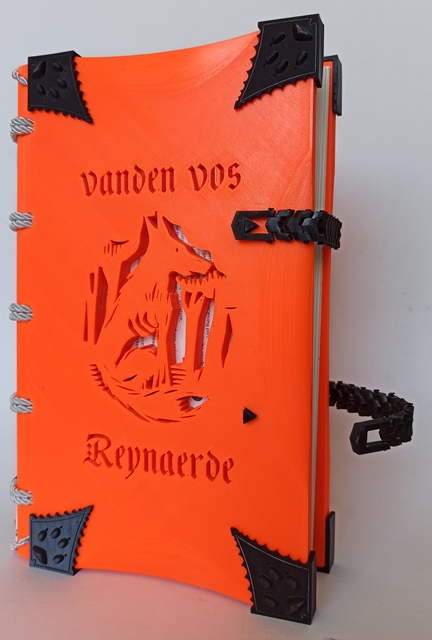
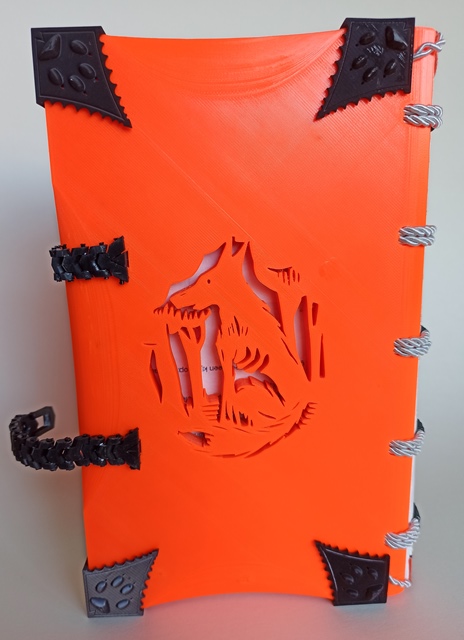
We processed the blindtooling in two ways. First, we designed the title, like fifteenth-century blindtooling, as a deepened relief. Second, we placed an image in the middle of the board to copy the figurative blindtooling. The image of the fox used, comes from the book and is on the verso side of the title page. We have not placed this image in deep relief like the title, but we have completely cut it out so that you can see the flyleaf through it. The choice for the two different processing methods stems from the desire to utilize the various possibilities of the 3D printer.

Book furniture
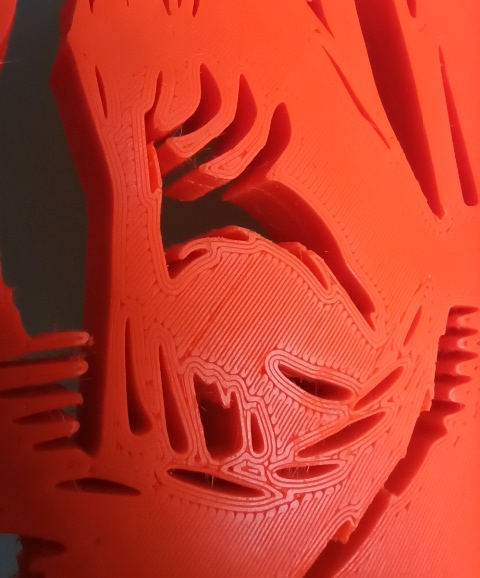
The books furniture is printed with a UV resin 3D printer. This printer works with liquid resin where the object to be printed is hardened by UV light. Where a print with PLA shows a clear, somewhat coarse layer structure (show above), a print from the resin printer is almost silky smooth and extremely detailed.
For the design of the corner pieces we were inspired by original fifteenth-century pieces. Sanne adopted the shape, the somewhat scaly edge and the integrated boss from a common fifteenth-century corner piece, but he replaced the normal round boss with a fox’s paw print in bas-relief. The two closures are a modern form of the strap fastening, in which a locking pin protrudes from the upper board and the strap, consisting of all loose, printed links, closes from the lower board around the front with a closing eye. All the book furniture was printed in black resin.

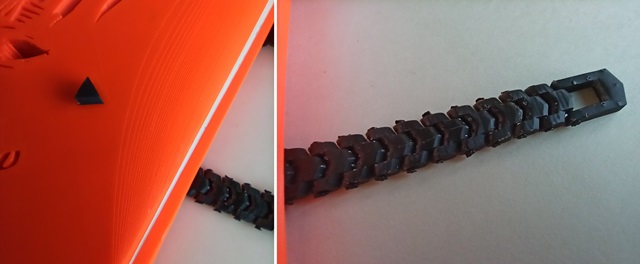
Right the strap, consisting of all loose, printed links, with a closing eye.
maculature / binders waste
One thing I find really interesting about old books is the use of membra disiecta, also called binders waste or maculature. Binders re-used (pages of) old books to reinforce new ones. This practice i wanted to add to the book, so I gave it a modern twist. In stead of parchment i used thin tyvek. And to make it maculature, I printed on the tyvek … ofcourse … parts of a 3D-printers manual. This printed tyvek I used to reinforce the spine, make stays in the hearts of the quires and two flyleafs.


Exposition, catalogue and lecture
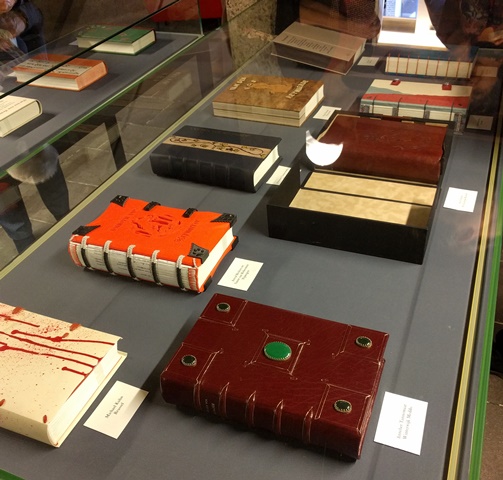
As I told we made this book for the challenge: ‘bind the book with a wink to the middle ages’. Everybody who accepted the challenge was invited to contribute with their book to a exposition and a catalogue. 64 books were admitted to the exposition and I was so proud seeing my book lying there, between amazing other bindings, but so very orange! There was no way you could not see it.
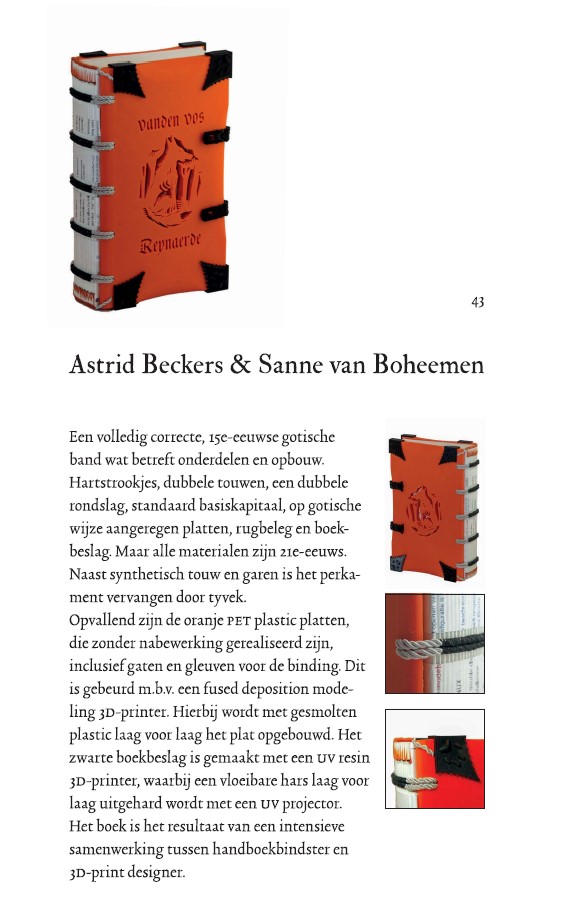
Together with the exposition there was a small catalogue where every binding got it’s own page.

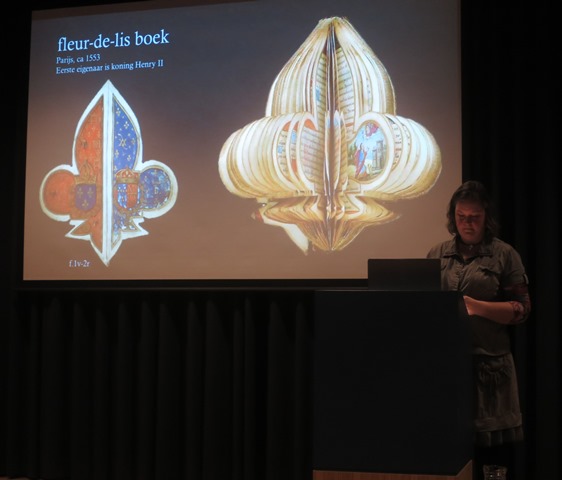
For the opening of the exposition there were 3 lectures about the medieval book, and I was asked for one of them. I told about all the different shapes of books that existed in the Middle Ages, and all about that you can read in the next blog.


 Bound for history
Leave a reply to Philipp Cancel reply