Jump to English text:
Using a rotating column indicator
Tussen de bladzijden van middeleeuwse handschriften zijn tientallen kolomwijswieltjes terug gevonden. Een klein, ingenieus apparaatje dat je precies vertelt waar je bent gebleven met lezen. Het doet wat het zegt: het kolomwijswieltje wijst met een wieltje de kolom aan waar je was gebleven.
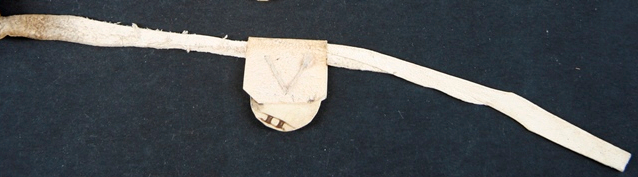
Kolomwijswieltjes zijn kleine, perkamenten draaischijfjes die aan een leeslint vast zitten. Hoewel allemaal verschillend (handwerk) lijken ze erg op elkaar.
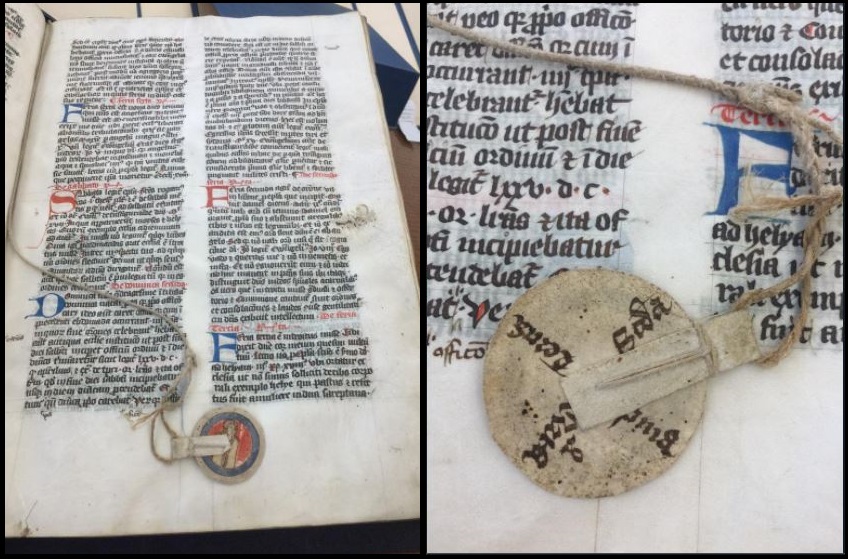
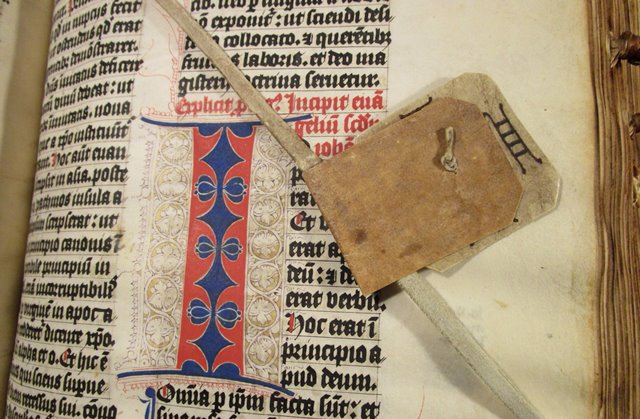
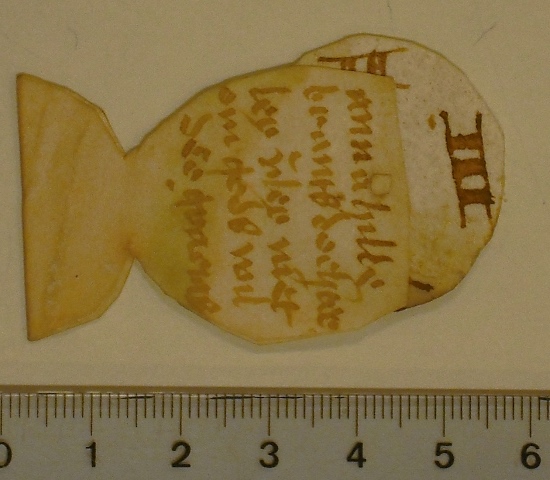
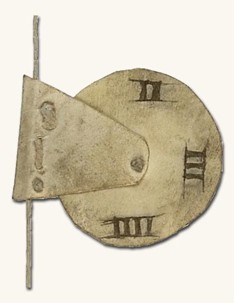
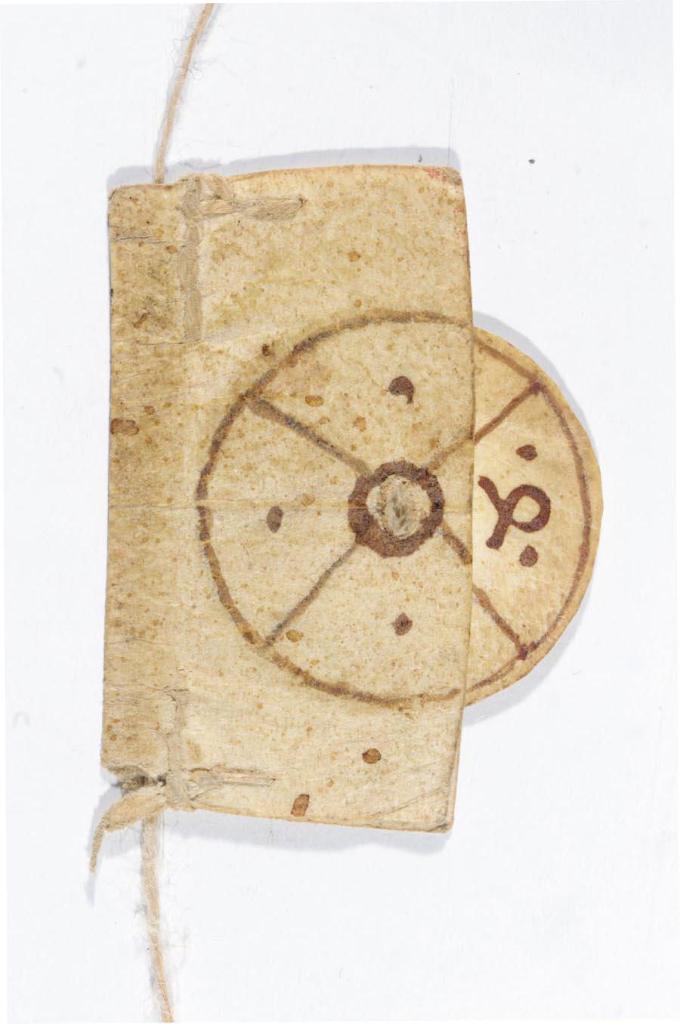
Kolomwijswieltjes zijn niet groot, een paar restjes perkament waren genoeg om er eentje te maken.
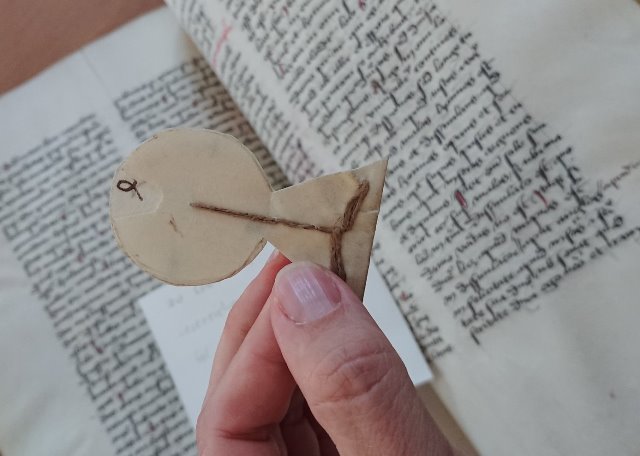
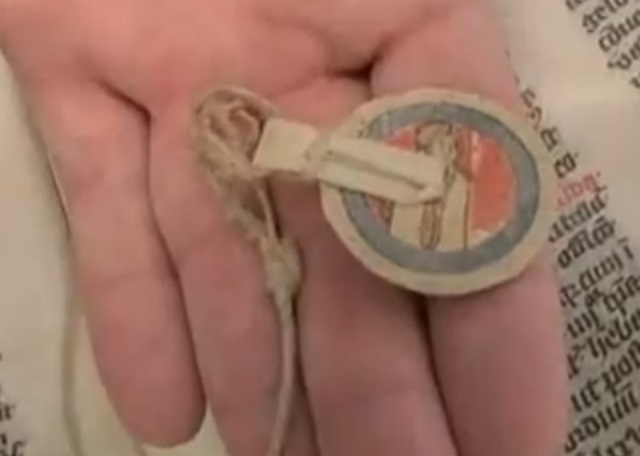
Onderdelen van een kolomwijswieltje
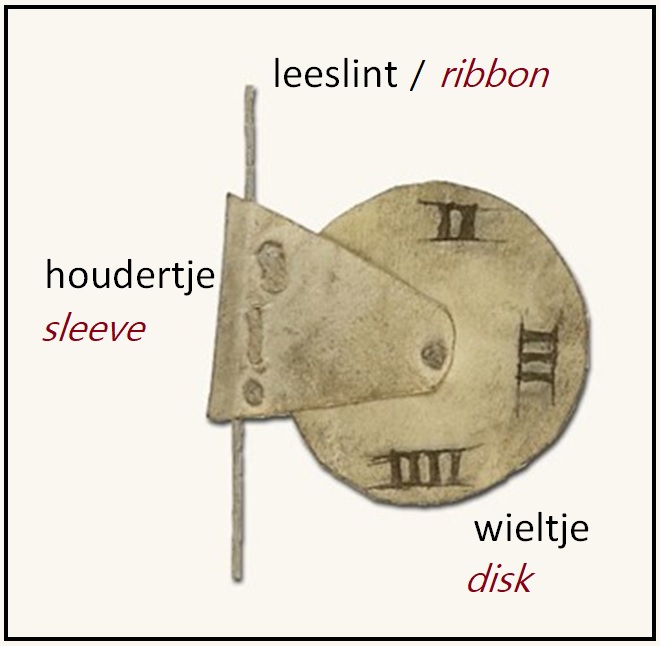
Een kolomwijswieltje bestaat uit 3 onderdelen die met 1 of enkele steken garen aan elkaar vast zitten.
- Een leeslint dat vaak bovenaan het boek vast zit aan het kapitaal. De nog bestaande kolomwijswieltjes hebben (resten van) leeslinten van touw, leer en textiel.
- Een wieltje van perkament met cijfers of letters dat draait in een houdertje. Op enkele wieltjes is versiering aangebracht maar dit is zeldzaam.
- Een houdertje dat is gemaakt van een dubbelgevouwen stuk perkament. Aan de ene kant zit het gevouwen om het leeslint waardoor het er niet af kan, aan de andere kant zit met touw het wieltje vast. Houdertjes heb je in alle soorten en maten, soms met wat versiering of tekst.
Hoe werkt een kolomwijswieltje?
Het kolomwijswieltje werkt op 3 manieren.
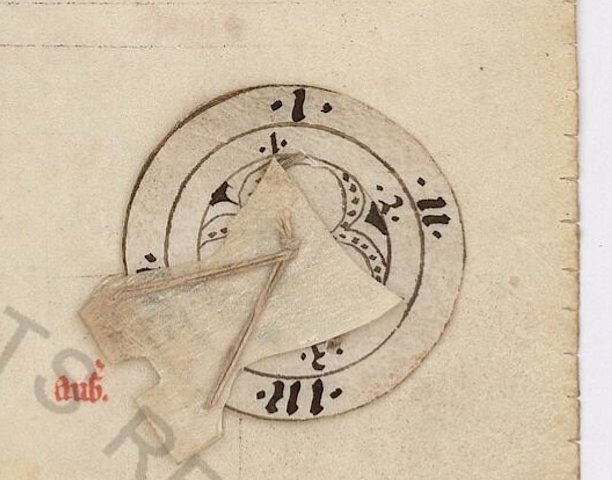
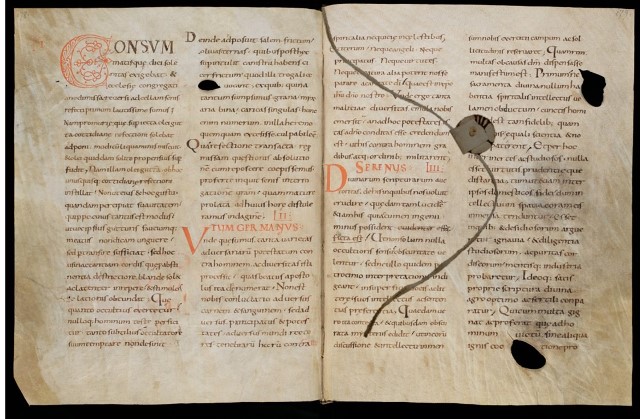
- Zoals elke boekenlegger, geeft het aan bij welke openslag je bent gebleven met lezen. Hieronder is dat dus f.278v-279r.
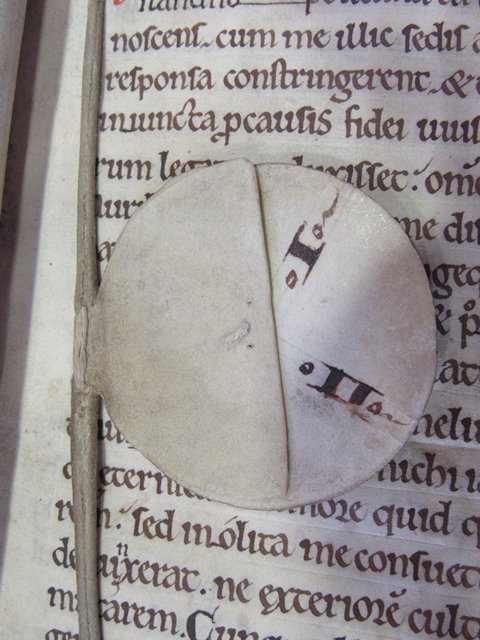
- het wieltje heeft een aantal tekens (letters, cijfers of woorden). Als het gemaakt is voor het boek waar het nu nog in ligt, zijn dat 2 tekens als de openslag 2 kolommen heeft, of 4 tekens als de openslag 4 kolommen heeft. Het boek hieronder heeft 4 kolommen en het wieltje geeft inderdaad 4 tekens aan: I, II, III en IIII. Het wieltje staat nu op IIII, dus de lezer is gebleven in kolom vier.
- Als laatste is de hoogte van het houdertje van belang. Want het kolomwijswieltje kan op en neer langs het leeslint bewegen. De lezer heeft, toen hij het boek dicht sloeg, het houdertje op de hoogte gebracht van de regel waar hij was. Als we dit leeslint iets recht leggen in gedachten zien we dat de lezer halverwege de 4e kolom weer verder moet gaan lezen.
Onze voorouders hadden een simpele maar zeer effectieve manier op precies te weten waar ze waren gebleven met lezen.
Using a rotating column indicator
Dozens of rotating column indicators have been found between the pages of medieval manuscripts. A small, ingenious device that tells you exactly where you stopped reading. It does what it says: the rotating column indicators uses a disk to indicate the column where you stopped.
rotating column indicators are small, parchment discs that are attached to a bookmark. Although they are all different (handmade), they look very similar.
Rotating column indicators are not big, a few scraps of parchment were enough to make one.
Parts of a rotating column indicator
A rotating column indicator consists of 3 parts that are attached to each other with 1 or a few stitches of yarn.
- A bookmark-ribbon that is often attached to the headband of the book. The still existing rotating column indicators have (remnants of) bookmarks made of rope, yarn, leather and textile.
- A disc made of parchment with numbers or letters that turns in a sleeve. Some discs have decorations, but this is rare.
- A sleeve that is made of a double-folded piece of parchment. On one side it is folded around the ribbon so that it cannot come off, on the other side the wheel is attached with yarn. Sleeves come in all shapes and sizes, sometimes with some decoration or text.
How does it work?
The rotating column indicator works on 3 levels.
- Like any bookmark, it indicates which opening you stopped reading. Below, that is f.278v-279r.
- The wheel has a number of characters (letters, numbers or words). If it was made for the book it is currently in, it has 2 characters if the opening has 2 columns, or 4 characters if the opening has 4 columns. The book below has 4 columns and the wheel does indeed indicate 4 characters: I, II, III and IIII. The wheel is now on IIII, so the reader has stopped in column four.
- Finally, the height of the sleeve is important, because the rotating column indicator can move up and down along the ribbon. When the reader closed the book, he placed the sleeve at the same height as the line where he was reading. If we straighten this ribbon a bit in our minds, we see that the reader should continue reading halfway through the 4th column.
Our ancestors had a simple but very effective way of knowing exactly where they left off while reading.
 Bound for history
Leave a comment