Tweetalig blog: Nederlandse tekst halverwege.
Bilingual blog: Dutch text halfway.
The reuse of old books into new books is as old as the book itself. To date, attention has mainly been focused on the reuse of pages and certificates, which were used by the bookbinder as spine reinforcement, stays, flyleafs or covers. This is called maculature, binders waste or membra disiecta. But the bindings of these reused books were also used in new books.
A book binding consists of several parts, all of which can be reused if you take the book and the binding apart. You are left with boards, covering material and book fittings that would not be out of place for a second life. An initial search for this recycled binding material yields a corpus of 170 books, from the period 9th century to 20th century, and from England to Greece, from Scandinavia to Spain. Time to pay more attention to this intriguing habit.
Twice or thrice used boards?
A very nice example of reused wooden boards is B V 14 from the University Library of Basel. The leather leaves part of the boards exposed, allowing a clear view of all kinds of holes and grooves on the right side of the front board, filled with old rope. What is going on here?

Carolingian manuscript
This ninth century manuscript was produced in Lorsch (Germany) and later reached the Carthusian Monastery of Basel. It contains the second part of the Collationes Patrum by John Cassian, volume B V 13 contains the first part.
The binding is no longer the original ninth-century binding, which must have been a Carolingian binding. The raised sewing supports, the headbands and the bevelled boards indicate a Gothic rebinding, somewhere between the 13th and 15th century.

The intriguing part of the front cover is the slits. There are 4 horizontal slots with string in them, 3 vertical slots without string and 2 diagonal slots on the corners, the bottom one which still contains a piece of string. These appear to be the sewingsupports of another book binding, this piece of wood has previously served as a board for a book. Was it perhaps part of the first binding of this book?
Examining the boards
To answer this question, we first look at what is visible and what is not. What do the back cover and the inside of the covers look like? Unfortunately, the flyleaves are firmly in place, so the inside of the wooden boards, which could tell a lot, remain quiet. Remarkably, the back cover shows no trace of old holes, grooves or ropes. Can it be there, but could it be under the leather? Only a physical examination of the book can reveal this, by feeling carefully whether any irregularities can be felt under the leather. For now we have to make do with photos.

A carolingian binding
Fortunately, the front shows more. There are holes in the end of the board at the same height as the 3 vertical slots. 2 are clearly visible, the third is filled with a wooden plug. This confirms an initial suspicion: the 3 vertical slots, these 3 holes and the 2 diagonal slots belong together and are the remains of a Carolingian book binding of which this board was once part.

The next question is whether this cover was also part of the first volume of this book, or whether it belonged to another sourcebook. (I use the word sourcebook as the translation of bronboek. Is means the first bookbinding the reused part belonged to, the source of this part) To do this, we look at the position of all sewingsupports and the sewing holes in the heart of the quires. It is not difficult to see from the outside that a straight line can be drawn between the location of the current Gothic bindings and the holes of the Carolingian connection.

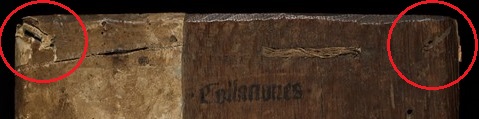
Then we look at the location of the 2 diagonal slots on the corners. These are the slots through which the headband-supports were passed. On the left is the current leather headband-support which is clearly visible due to wear and tear. On the right, the diagonal slot of the capital core of the source book. The fact that both old grooves are still there, and are exactly on the corners, means that this flat was not sawn smaller for reuse, it had exactly these dimensions on the source book. So the sourcebook was exactly the same size as the current book.
Unused sewingholes?
Finally, we look at the hearts of the quires. This book has been rebound, and we want to know if the bookbinder reused the same sewing holes or if he made new holes and therefore there are unused sewing holes from the first binding. If there are unused sewing holes, the first volume had a different number of sewingsupports in other places and this board could therefore not have belonged to this bookblock earlier.
But nowhere are unused holes visible. The current 5 holes are the only ones, so the first binding also only had 3 supports, in exactly the same place. (the other 2 holes are from the crossover-stitching)

We can therefore assume that this board belonged to both the first binding belonging to thist book and the current binding.
Firstly, the first binding was Carolingian, because the book was made in the 9th century. The holes and grooves indicate a typical Carolingian board attachment.
Secondly, the current sewing supports and the Carolingian are at exactly the same height and there are no unused sewing holes.
Third, the cover has not been reduced in size, it is exactly the same size as when it was around the sourcebook.
But what about those other slots?
Back to the outside of the front cover. There are also 4 horizontal slots in the middle of the wood, filled with rope. And these pose a little mystery.
These types of horizontal grooves, in this place, with rope, indicate a Romanesque board attachment. This suggests that this board was also used in a Romanesque binding. In principle that is possible, then this book has been rebound twice, and on a timeline of 600 years that is not strange.
That would mean that the Carolingian holes we just looked at were the first binding, that these Romanesque slots and ropes were from a second binding, and that the current Gothic binding is the third.
| Carolingian binding | Romanesque binding | Gothic binding |
| 9th – 12th century | 11th – 14th century | from 14th century |
But there are three problems with this conjecture. First of all, there are 4 slots for 4 sewing supports, and we have already seen that the book block only has holes for 3 supports. This bookblock has never been bound on 4 ropes.
Secondly, the location of the slots indicates a larger book than the current size. The top slot is too close to the top and there are no holes for the headband-supports.
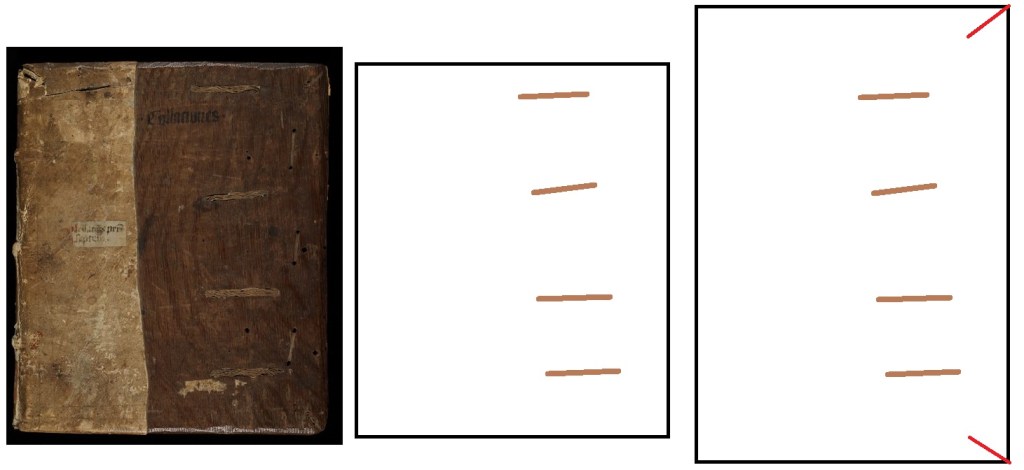
And third, the holes at the front-edge that belong to the slots are missing. With the 3 Carolingian slots there were 3 holes in the edge of the wood where the ropes entered the wood. These 4 slots should also have holes for the rope, but nothing is visible. Not on the front side, not on the inside of the front cover.
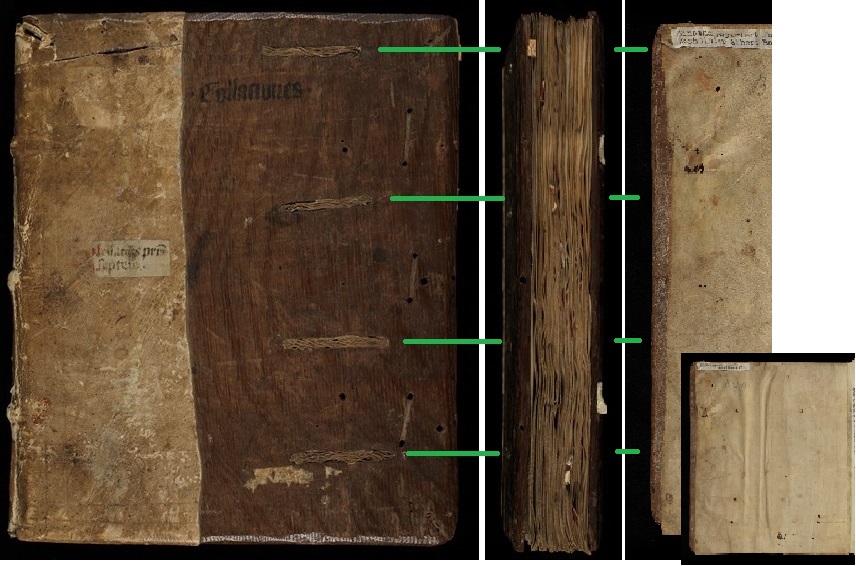
There is one more possibility, and that is that the 4 grooves are indeed a Romanesque binding for a larger sourcebook, but that the ropes came into the board from the current spine. These grooves are then very far into the board, but there are known examples where the Romanesque ropes were extended quite far through the wood. Then the holes that should be in the edge of the wood are now hidden under the leather.
But then the time is wrong. If this wood was first used for a much larger book, and was sawn smaller in the ninth century and used for this book, it could never have been a Romanesque binding since they were only created two centuries later, in the 11th century. Chronologically it is only correct if it was first a Carolingian binding, then a Romanesque and then a Gothic, but then the size of the cover is incorrect.
At this point I must admit that I am puzzled. Could it be that this piece of wood, before it was used in a binding in the ninth century, had a life as something completely different? Something that left bits of string glued into slots? I really don’t know. With everything I know about medieval houses, kitchens, monasteries, furniture and utensils, this doesn’t fit anywhere.
So, if you have an idea what this board was, before it became part of a binding in the 9th century, let me know in the comments! Or do you have a theory how it could have been a Romanesque binding, share it with me!
Banden in banden – 1
Het hergebruik van oude boeken in nieuwe boeken is zo oud als het boek zelf. Tot op heden is de aandacht vooral gericht op het hergebruik van bladzijden en oorkonden, die door de boekbinder werden gebruikt als onder andere rugversteviging, hartstrookjes, dekbladen of omslagen. Dit wordt maculatuur of membra disiecta genoemd. Maar de boekbanden van deze hergebruikte boeken werden óók gebruikt in nieuwe boeken.
Een boekband bestaat uit meerdere onderdelen, die allemaal hergebruikt kunnen worden als je het boek en ook de band uit elkaar haalt. Je houdt platkernen, bekledingsmateriaal en boekbeslag over dat een tweede leven niet misstaat. Een eerste zoektocht naar dit hergebruikte bandmateriaal geeft een corpus van 170 boeken, uit de periode 9e eeuw tot 20e eeuw, en van Engeland tot Griekenland, van Scandinavië tot Spanje. Tijd voor meer aandacht voor deze intrigerende gewoonte.
Tweemaal of driemaal gebruikte platkernen?
Een zeer mooi voorbeeld van hergebruikte houten platkernen is B V 14 uit de Universiteitsbibliotheek van Basel. Het bekledingsleer laat een deel van de platten vrij, waardoor er vrij zicht is op allerlei gaten en gleuven aan de rechter kant van het voorplat, gevuld met oud touw. Wat is hier aan de hand?
This ninth century manuscript was produced in Lorsch (Germany) and later reached the Carthusian Monastery of Basel. It contains the second part of the Collationes Patrum by John Cassian, volume B V 13 contains the first part.
De band is niet meer de originele negende-eeuws band hetgeen een karolingische band moet zijn geweest. De opliggende ribben, het kapitaal en de afgeschuinde platten duiden op een gotische herbinding, ergens tussen de 13e en de 15e eeuw.
Het intrigerende deel van het voorplat zijn de gleuven. Er zijn 4 horizontale gleuven met touw erin, 3 verticale gleufjes zonder touw en 2 diagonale gleufjes op de hoeken waarvan de onderste nog een stukje touw bevat. Dit lijken de bindingen van een andere boekband te zijn, dit stuk hout heeft al eerder dienst gedaan als platkern voor een boek. Was het wellicht onderdeel van de eerste band van dit boek?
Om deze vraag te beantwoorden kijken we eerst naar wat er allemaal zichtbaar is en wat niet. Hoe zien het achterplat en de binnenkant van de platten eruit? Helaas zitten de dekbladen stevig op hun plek, dus de binnenkant van het hout, dat veel zou kunnen vertellen, houdt zich stil. Het achterplat laat opvallend genoeg geen enkel spoor zien van oude gaten, gleuven en touwen. Zou dit hout het wel hebben, maar zou het onder het leer kunnen zitten? Alleen fysiek onderzoek van de band kan dat uitwijzen, door goed te voelen of er onregelmatigheden onder het leer voelbaar zijn. Voor nu moeten we het doen met foto’s.
De frontzijde laat gelukkig meer zien. op gelijke hoogte met de 3 verticale gleufjes zitten er gaten in de kopse kant van het hout. 2 zijn goed zichtbaar, de derde is opgevuld met een houten plugje. Dit bevestigt een eerste vermoeden: de 3 verticale gleufjes, deze 3 gaatjes en de 2 diagonale gleufjes horen bij elkaar en zijn de restanten van een karolingische boekband waar dit plankje ooit onderdeel van uitmaakte.
De volgende vraag is of dit plat ook onderdeel was van de eerste band van dít boek, of dat het bij een ander bronboek hoorde. Daarvoor kijken we naar de positie van alle bindingen en de naaigaten in het hart van de katernen. Het is niet moeilijk te zien aan de buitenkant dat er een kaarsrechte lijn te trekken is tussen de plek van de huidige gotische bindingen en de gaten van de karolingische aanrijging.
Dan kijken we naar de plek van de 2 schuine gleufjes op de hoeken. Dit zijn de gleuven waar de kapitaalbindingen doorheen werden gehaald. Links is de huidige leren kapitaalkern die dankzij slijtage duidelijk zichtbaar is. Rechts de diagonale gleuf van de kapitaalkern van het bronboek. Het feit dat beide oude gleufjes er nog zijn, en exact op de hoeken zitten, betekent dat dit plat voor het hergebruik niet kleiner is gezaagd, het had exact deze afmetingen op het bronboek. Het bronboek had dus exact dezelfde grootte als het huidige boek.
Als laatste kijken we naar de harten van de katernen. Dit boek is herbonden, en we willen weten of de boekbinder dezelfde naaigaten opnieuw heeft gebruikt of dat hij nieuwe gaten heeft gemaakt en er dus ongebruikte naaigaten zijn van de eerste band die het boekblok had. Als er ongebruikte naaigaten zijn, had de eerste band een ander aantal bindingen op andere plekken en kan deze platkern dus niet bij dit boekblok hebben gehoord.
Maar nergens zijn ongebruikte gaten zichtbaar. De huidige 5 gaten zijn de enige, dus ook de eerste band had maar 3 bindingen, op exact dezelfde plek. (de andere 2 gaten zijn van het oversteek-naaisel)
We kunnen dus aannemen dat deze platkern zowel bij de eerste band hoorde die dit boek had, als bij de huidige band.
Ten eerste was de eerste band een karolingische, want het boek is in de 9e eeuw gemaakt. De gaten en gleuven duiden op een typische karolingische plataanrijging.
Ten tweede zitten de huidige bindingen en de karolingische op exact dezelfde hoogte en zijn er geen ongebruikte naaigaten.
Ten derde is het plat niet kleiner gemaakt, het heeft nog precies dezelfde afmeting als toen het om het bronboek zat.
Maar die andere gleuven dan?
Terug naar de buitenkant van het voorplat. Midden in het hout zitten ook nog 4 horizontale gleuven, gevuld met touw. En deze vormen een klein mysterie.
Dit soort gleuven, op deze plek, met touw, duiden op een romaanse plataanrijging. Dat doet vermoeden dat deze platkern ook is gebruikt in een romaanse band. Dat kan in principe, dan is dit boek 2x opnieuw gebonden, en op een tijdslijn van 600 jaar is dat niet vreemd.
Dat zou betekenen dat de karolingische gaten die we net hebben bekeken de eerste band waren, dat deze romaanse gleuven en touwen van een tweede band waren en dat de huidige, gotische band de derde band is.
| karolingisch aanrijging | romaans aanrijging | gotisch aanrijging |
| 9e tot 12e eeuw | 11e tot 14e eeuw | vanaf 14e eeuw |
Maar er zijn drie problemen met dit vermoeden. Ten eerste zijn er 4 bindingen, en we hebben al gezien dat het boekblok maar gaten heeft voor 3 bindingen. Dit boekblok heeft nooit gebonden gezeten op 4 touwen.
Ten tweede duiden de plek van de gleuven op een groter boek dan het huidig formaat. De bovenste gleuf zit te dicht tegen de bovenkant aan én er zijn geen gaten voor de kapitaalbindingen.
Ten derde missen aan de frontzijde de gaten die horen bij de gleuven. Bij de 3 karolingische gleuven zaten er 3 gaten in de kopse kant van het hout waar de touwen het hout binnen kwamen. Bij deze 4 gleuven zouden ook gaten moeten zitten voor het touw, maar er is niets te zien. Niet aan de kopse kant, niet aan de binnenkant van het voorplat.
Er is nog één mogelijkheid, en dat is dat de 4 gleuven inderdaad een romaanse aanrijging zijn maar dat de touwen vanuit de huidige rug kwamen. Dan zitten deze gleuven wel érg ver in het plat, maar er zijn voorbeelden bekend waarbij de romaanse touwen vrij ver werden doorgevoerd door het hout. Dan zitten de gaten die in de kopse kant van het hout moeten zitten nu verborgen onder het leer.
Maar dan klopt de tijd niet. Als dit plankje eerst voor een veel groter boek is gebruikt, en in de negende eeuw kleiner werd gezaagd en werd gebruikt voor dit boek, kan het nooit een romaanse band zijn geweest aangezien die pas twee eeuwen later ontstonden, in de 11e eeuw. Chronologisch klopt het alleen als het eerst een karolingische band was, toen een romaanse en daarna een gotische, maar dan klopt de grootte van het plat niet.
Op dit punt moet ik toegeven dat ik voor een raadsel sta. Kan het zijn dat dit stuk hout, voordat het in de negende eeuw werd gebruikt als platkern, een leven had als iets totaal anders? Iets waardoor er stukjes touw in gleuven zat gelijmd? Ik weet het niet. Bij alles wat ik weet over middeleeuwse huizen, keukens, kloosters, meubels en gebruiksvoorwerpen past dit nergens.
Mocht je een idee hebben hoe het zit met de 4 horizontale gleuven, laat het me weten in de reacties!
 Bound for history
Leave a comment