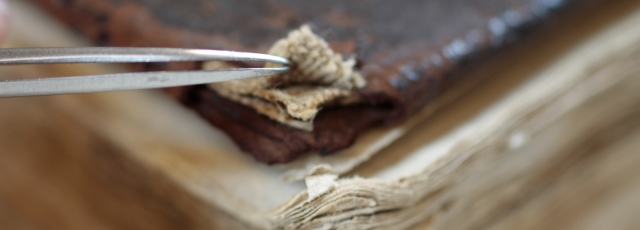
Boards made of linen, no sewing supports, leather covering and a fake endband… one of the most intriguing 15th century bindings I’ve met.
The Regionaal Archief Nijmegen (RAN) houses a collection of 43 non-related codices: ‘archive 546 – collectie codices tot het jaar 1600’. There is one book in this collcetion that raises a lot of codicological questions: codex 18.
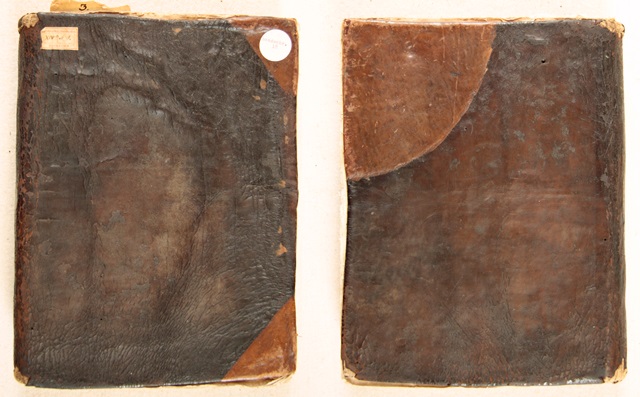
My first thought was: ‘ah, another Gothic binding.’ But no, I was wrong. Also yes, the person who made this book was trying to make it look like a Gothic binding, but it doesn’t even get close. So what kind of binding is this?
The boards
First of all, the boards are very uncommon. They are thin. Due to reparations that have been done to the book in the past (not recently, probably 16th c) the ‘new’ pastedowns are glued so tightly to the boards it is impossible to see the inside.

Luckily the corners of the boards have been damaged. Imagine saying that about a 600 year old book: ‘luckily it has been damaged!’ But yes, to be honest, when you are studying old bookbindings, a lot of information comes to you due to damaged parts, giving the opportunity to peek inside. And especially this book only tells its mysterious story due to these damaged parts.

This is the lower corner of the lower board, where the leather has gone and where it shows us the board material. It is linen! To be precise: five layers of rather coarse linen, glued together to make up the board. I have seen books that have been covered with textile, but never encountered a medieval one that has textile as boards. If you did, please let me know in the comments!!
The lack of sewing supports

The spine, which is completely smooth and is lacking the typical raised bands of the Gothic binding, fortunately has a big tear. And this tear is revealing a story! Peeking inside we see linen, again, and some huge yarn stitches on the outside of the linen. How has this book been sewn together?

Right: the linen of the spine visible right of the stay.
Another spot where we can take a peek is where the first ànd the last three quires are torn out, only leaving the parchment stays (binders waste/maculature!!). Due to this violation we can see that the linen is covering the spine completely, from top to bottom (right picture). We can also see that there is no connection to the linen that makes up the boards because we can see a dash of the covering leather between them (left picture).
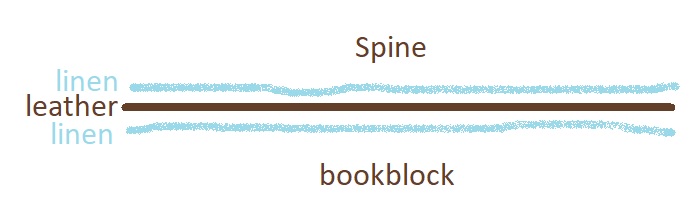
Thanks to a lot of other peek-throughs, impossible to photograph, I found out that the quires are sewn onto a kind of strap as big as the entire spine of the text block. It is not just one material/strap, but it consists of three layers: linen (same as the boards linen), leather (possible the same as the covering material), linen (same as the board’s linen). I could not see if they are glued together or not. The quires are sewn onto this strap.
The sewing of the quires
Normally, the quires are sewn to sewing supports made out of rope or leather, and because of that all the sewing stations are alike in every quire. They are in the same place and each quire has the same amount of holes. One for each sewing station and two for the direct change-overs/chain stitch.1
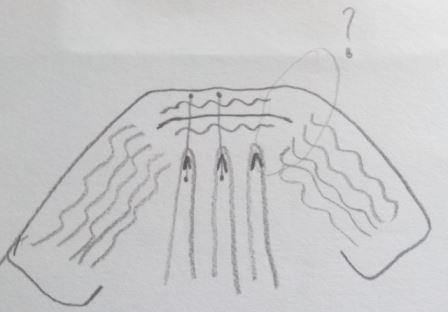
Since there are no sewing stations, I took a look at the sewing holes in the heart of every quire. And here it gets even stranger… there is no logic whatsoever to be found in the sewing holes. Except for the first and last, all the holes are just scattered through the quires.

Plus, not every quire has the same amount of holes! Six is the fewest, eleven is the most. Even stranger, some have an even, some an uneven number of holes. Logic dictates that it should be an even number: you start at the outside of the strap, going into the quire, then out-in, out-in (etc), and you end with going out of the quire. So, an even number.
The probable answer is given by the damage at the endbands:
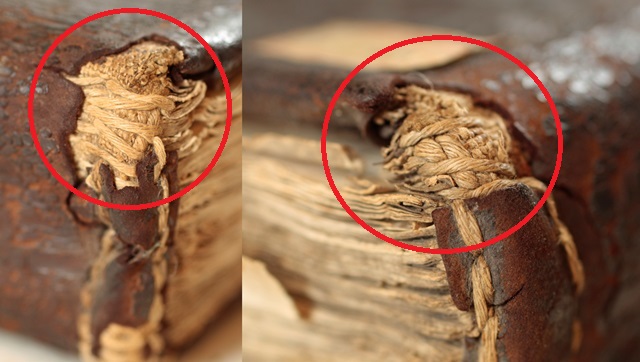
In the red circles you see the end of the linen strap and some huge stitches going around it. I think the binder sew the quires completely at random as regards to the place of the sewing stations. And when she ended inside the quire at the last sewing station, she just pulled the thread to the end of the quire, around the top and down along the spine after which she entered a new quire. These ‘around the top and down along the spine’ are the stitches we see here.
A fake endband
At the beginning I wrote that the binder was trying to make the book look like a gothic binding. The endbands are the spoiler here.
A gothic binding always has an endband (at least, I have never heard of one that did not). And the most common in The Netherlands is the saddle-stitch endband. It is made with, of course, a saddle-stitch.
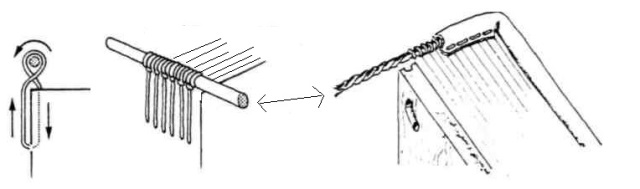
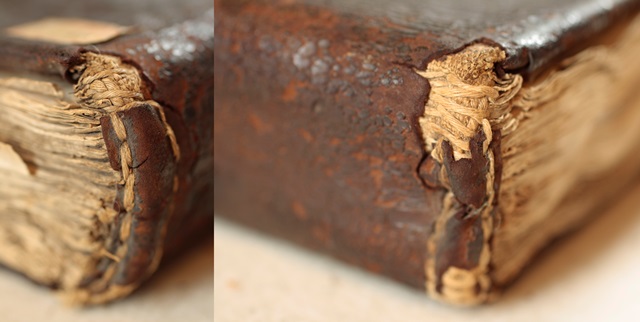
Codex 18 looks like it has a saddle-stitch endband, but that is not so. There is no primary sewing and no endband support/core. Although, there are two pieces of thin rope visible underneath the stitches of the quires, it this some kind of endband core? What the binder did, was folding the leather around the ends of the linen/leather straps and then she just made a saddle-stitch through it. The whole thing has nothing to do with protection (the sole purpose of a medieval endband) and has no firmness what so ever, it just mimics the endband of a gothic binding.
Yes, you can discuss whether or not this is a saddle-stitch endband. It is an endband and a saddle stitch has been used for it.. For now I’m sticking to the definition of Kneep & Binding as far as the word saddle-stitch endband is concerned.
Who bound this book?
The origin of the book is uncertain. In view of the fact that the life of St. Elisabeth, who was venerated in Franciscan circles as one of the first female tertiaries, has been added to the series of sermons, apparently without any connection to the other texts, it is not impossible that the book was intended for a monastic community of women with a tertiary rule. In medieval Nijmegen there were two tertiary monasteries (Hessenberg and Groesbeekshof) so maybe it was made there.
It is possible that the monastery copied books for its own use but that it didn’t have a sister who could do the binding. There were monasteries with bookbinders in Nijmegen, besides some artisans in the city centre. Maybe the sisters copied their own books and had them bound by others. Maybe they didn’t have the money to bind this book, so a crafty sister said: I will do it. I have seen how they do it, I can do this too.
It could be the reason why this book is bound in a way a professional binder would not have done it. Why it looks like a gothic binding but it isn’t. Why there is no blind tooling, because you need professional equipment for that. Why there are no closures, because you need money and knowledge to make and add them. Why the sewing of the quires resembles more the sewing of a garment instead of the sewing of a book, because she did what she knew. Why the boards are made of linen, that was available in a women’s monastery, and not out of wood because it would take knowledge to make a wooden board. For now I think this book was a stand-alone project of the nuns, trying to make a book with what they knew and what they had lying around. Up till now I had not seen another book like this but I will keep on looking and asking. So if you know of one, please tell me!
Footnotes
- This is normal for the medieval ‘wood covered with leather’-bindings. Later bindings are quite a different story regarding sewing stations (like: the amount of holes belonging to one sewing support can differ from one to two and not every sewing station is used for every quire or not every hole is used).


 Bound for history
Leave a comment